Portrait of Phillip IV
1622
46" x 38.5" Framed: 55" x 50"
Painting, oil on canvas
Region: Europe, Spain
46" x 38.5" Framed: 55" x 50"
Painting, oil on canvas
Region: Europe, Spain
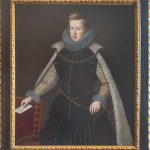
In this three-quarter portrait of the 17-year-old king, young Philip faces the viewer, his right arm extended and resting on the back of a chair upholstered in red. He holds a dossier inscribed with the name of the king's secretary: Senor/Garçi gallo desca / lado Secretario/ De Vuestro M. His left hand rests on the hilt of his sword.
Philip's strawberry blond hair is swept back from his face. His wears a blue ruff and matching ruffled cuffs, a burgundy doublet with gold buttons and gold and white sleeves, burgundy breeches with gold thread embroidery and a long cape lined in a rich horizontal striped silk.
Provenance: This portrait was recorded, with attribution, in the inventories of Galló de Escalada's collection, in 1624 and following his death in 1648.
Literature: William B. Jordan, “Juan van der Homen y León & the Court of Madrid” New Haven & London: Yale University Press, 2005. p. 122-124, illustration figure 7.5
This painting was thought to have been painted by Bartolomé Gonzalez, but it has since been attributed to Viilandrando. It is one of the the earliest known portraits of Philip after his assent to the throne.
Philip's strawberry blond hair is swept back from his face. His wears a blue ruff and matching ruffled cuffs, a burgundy doublet with gold buttons and gold and white sleeves, burgundy breeches with gold thread embroidery and a long cape lined in a rich horizontal striped silk.
Provenance: This portrait was recorded, with attribution, in the inventories of Galló de Escalada's collection, in 1624 and following his death in 1648.
Literature: William B. Jordan, “Juan van der Homen y León & the Court of Madrid” New Haven & London: Yale University Press, 2005. p. 122-124, illustration figure 7.5
This painting was thought to have been painted by Bartolomé Gonzalez, but it has since been attributed to Viilandrando. It is one of the the earliest known portraits of Philip after his assent to the throne.

About the Artist
(1588 - 1622)
Rodrigo de Villandrando (1588 – December 1622) was a court painter during the reign of Philip III of Spain. He worked in the tradition of Alonso Sánchez Coello and Juan Pantoja de la Cruz.The son of a musician from His Majesty's Chamber, Villandrando became a chamber usher in 1621. He trained as a court portrait painter with Juan Pantoja de la Cruz and became one of his most skilled disciples. His own work echoes his teacher's, prolonging the tradition that precedes Sánchez Coello's and presents royal figures with wooden severity and a plethora of minor details. These works repeated complex schemes of symbolic staging designed to convey a sense of royal majesty.
Villandrando is known to have had close relations with various court figures as well as a relatively comfortable economic situation, which was uncommon among his fellow painters at that time.
After he died, his post as king's painter was occupied by Velázquez. Villandrando also painted religious works, which are now in various locations, including the monastery of Las Descalzas Reales in Madrid and the Carmelite convent at La Cuerva de Toledo.
His best-known and most valued compositions, royal portraits of Philip IV and his wife, Elizabeth of Bourbon (Prado), reflect that period's approach to likenesses of royal figures, described above.